


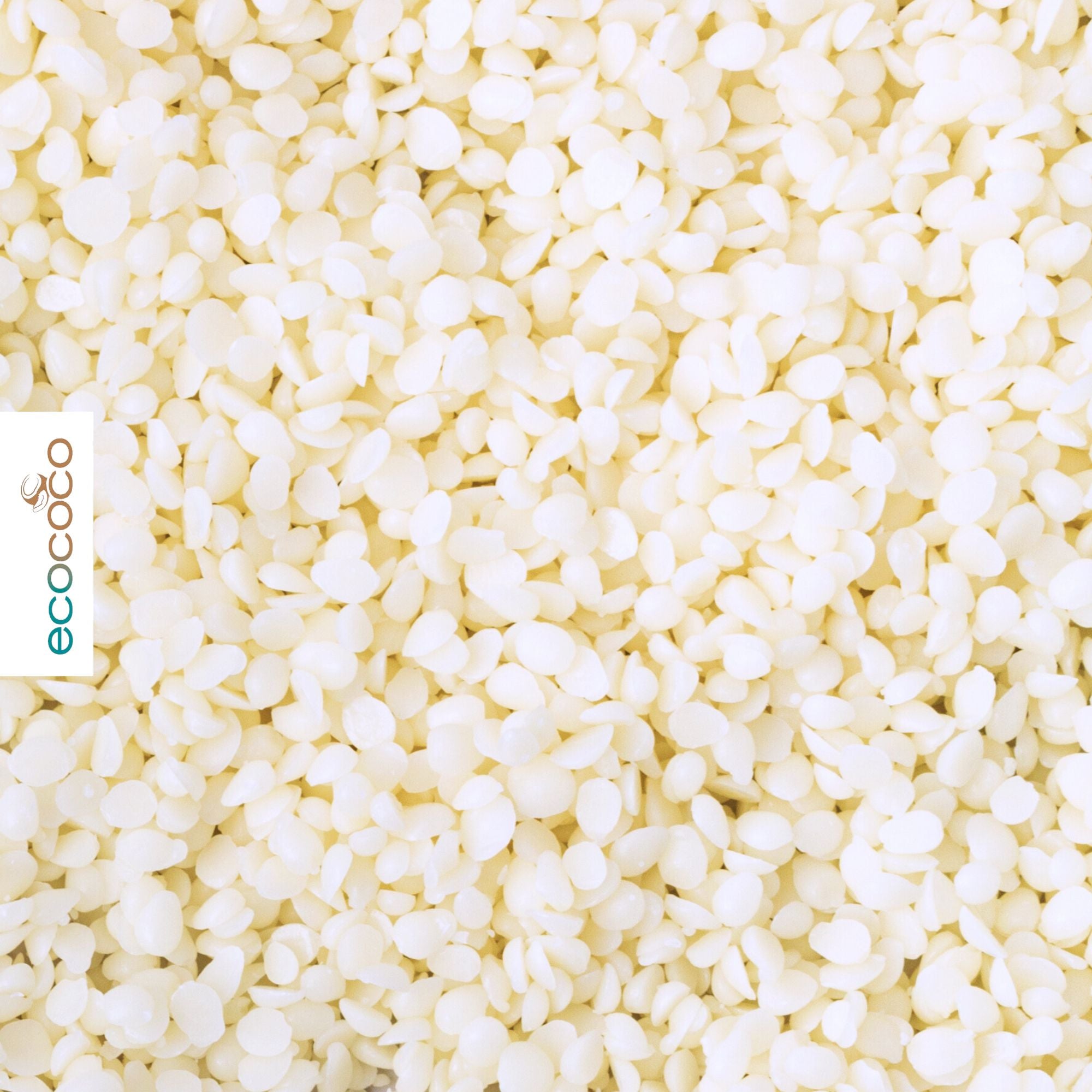

Coconut wax is becoming more and more popular every year with artisan wax-makers and enthusiasts of natural creations. Derived from coconut oil and processed using a controlled hydrogenation process, it has everything modern designers are looking for when it comes to combining impeccable aesthetics, olfactory performance and a responsible commitment.
With its luminous white colour, soft texture and particularly clean burn, it is one of the most advanced vegetable waxes for scented candles and fondants. Biodegradable, vegan and derived from a sustainable resource, it embodies a new generation of conscious, refined raw materials. Coconut wax is often referred to as a luxury wax, as its selling price is slightly higher than that of other vegetable waxes.
The origins and manufacture of coconut wax
Made from the oil extracted from the flesh of the coconut, this wax is obtained by hydrogenation, which naturally stabilises the saturated fatty acids.
Hydrogenation simply consists of solidifying a liquid vegetable oil to make it more stable over time and when exposed to heat. The material remains 100% vegetable: its nature is not altered, only its consistency and regularity improved to make it perfectly suited to candle making.
The result is a wax that is smooth, shiny, homogenous and particularly pleasant to work with. Its fatty acid-rich structure gives it a distinctive signature: a creamy texture and a brilliant white finish, ideal for meticulous creations.
The benefits of coconut wax for candles
Coconut wax is regularly cited as one of the best allies for artisans who want to offer premium creations with an impeccable sensory finish.
A sustainable and naturally responsible choice
Coconut wax is a pure vegetable wax, manufactured without petrochemical derivatives and entirely biodegradable, just like olive wax. When coconut plantations are grown using responsible practices, they enable production that respects the tropical ecosystem, with no negative impact on local biodiversity.
Its controlled environmental footprint makes it a choice option for designers who want to offer more virtuous candles and fluxes, while guaranteeing impeccable quality.
Clean, stable and refined combustion
Coconut wax burns slowly, evenly and almost completely without soot. Its homogenous melt gives a clean surface right from the first pour, reducing the need for touch-ups and optimising production time.
Its low melting point gives it a unique softness, ideal for container candles and particularly appreciated for massage candles. The flame remains stable and the fragrance is diffused with the characteristic roundness of coconut.
Certain top-of-the-range blends developed for moulded candles, such as those from Kerax or EcoCoco, are renowned for their natural hardness and meticulous finish. Their clean, even burn enhances the premium character of these creations.
A healthy wax, suitable for indoor spaces
Unlike coconut oil, wax has no strong odour. It is therefore perfectly suited to fragrances without altering them. Vegan, not tested on animals and free from toxic substances, it ensures a calm combustion that respects indoor air quality.
Our main coconut wax references
We offer a range of coconut waxes suitable for container candles, moulded candles and melts, as well as blends designed for making massage candles.
Coconut wax for Kerax jar candles
White, creamy and naturally shiny, this wax is ideal for container candles thanks to its stability and remarkable scent diffusion. Its white tint makes it easy to colour and guarantees a brilliant finish. It's a 100% natural blend of coconut wax and natural additives.
Coconut wax for Kerax fondants and moulded candles
This reference is perfect for stand-alone pillar candles. It offers excellent hold, easy removal from the mould and a clean surface. Its olfactory diffusion is effective both cold and hot, and it allows you to create precise shapes that retain their appearance for a long time.
It is suitable for polycarbonate, latex and metal moulds, and is accessible to beginners and experienced craftsmen alike.
Kerax coconut and soy wax for container candles
This blend combines the softness of coconut with the stability of soy. Its creamy texture adheres evenly to the walls, giving a smooth, even finish with a characteristic ivory hue.
Easy to work with thanks to its low melting point, it is also suitable for making massage candles. A slight natural odour can sometimes be detected, but this disappears as soon as the fragrance is added.
Cargill NatureWax Elite 600 rapeseed and coconut waxes
Available in blocks, this wax has a melting point between 20°C and 55°C. Its off-white to yellow colour gives a highly appreciated opaque finish. The combination of rapeseed and coconut offers an excellent balance between hold, sensoriality and ease of use.
Melting points according to wax type
- Coconut wax for Kerax candles: between 50°C and 58°C
- Coconut wax for Kerax fondants and moulded candles: 52 °C
- Coconut and soya wax for Kerax candles in jars: 50 °C
- Rape and coconut waxes for container candles: between 20°C and 55°C
Which wicks to choose with coconut wax
Container candles
Coconut wax works equally well with cotton or wooden wicks. Its density sometimes requires the use of a slightly wider wick than for petrochemical waxes.
The TCR, ECO, STABILO and LX series, as well as flat or round cotton wicks and wooden wicks, give very good results.
Moulded candles
For moulded candles and melters, flat or round cotton wicks, wooden wicks and tea light wicks are recommended. Tests are still essential to adjust the flame and the depth of the pool.
Colouring coconut wax
Thanks to its natural whiteness, coconut wax reproduces the pigments perfectly. Pastel shades and deeper colours appear with great uniformity.
- Granular dyes: 5
- Liquid dyes: 2%.
Granular colourants should be added to a wax heated to at least 75°C, while liquid colourants can be added from 70°C. The addition of a UV stabiliser of between 0.1% and 0.3% will improve colour fastness.
Incorporating fragrance into coconut wax
Melt the wax up to around 80°C, then add the fragrance when the temperature drops to around 75°C. A dosage of 7% to 10% is recommended for candles, and 10% to 15% for fondants.
Coconut wax is distinguished by its ability to retain fragrance oils evenly, ensuring a constant and harmonious diffusion, whether cold or hot.
Storing coconut wax
The wax should be stored in a cool, dry place away from light and heat. An airtight container prevents contamination by moisture or external odours, and ensures that its technical properties are preserved.
Conclusion
Coconut wax is an exceptional material for craftsmen in search of quality and sensoriality. Its clean burn, meticulous aesthetic finish and ability to enhance fragrances make it an essential ally for creating elegant, natural and long-lasting candles.
Adopting it means choosing a wax that's modern, responsible and of the highest quality. To find out more, take a look at our guide to the common problems associated with vegetable waxes, and make the most of your creations with complete peace of mind.


